
Integrated Resource & System Planning Platform
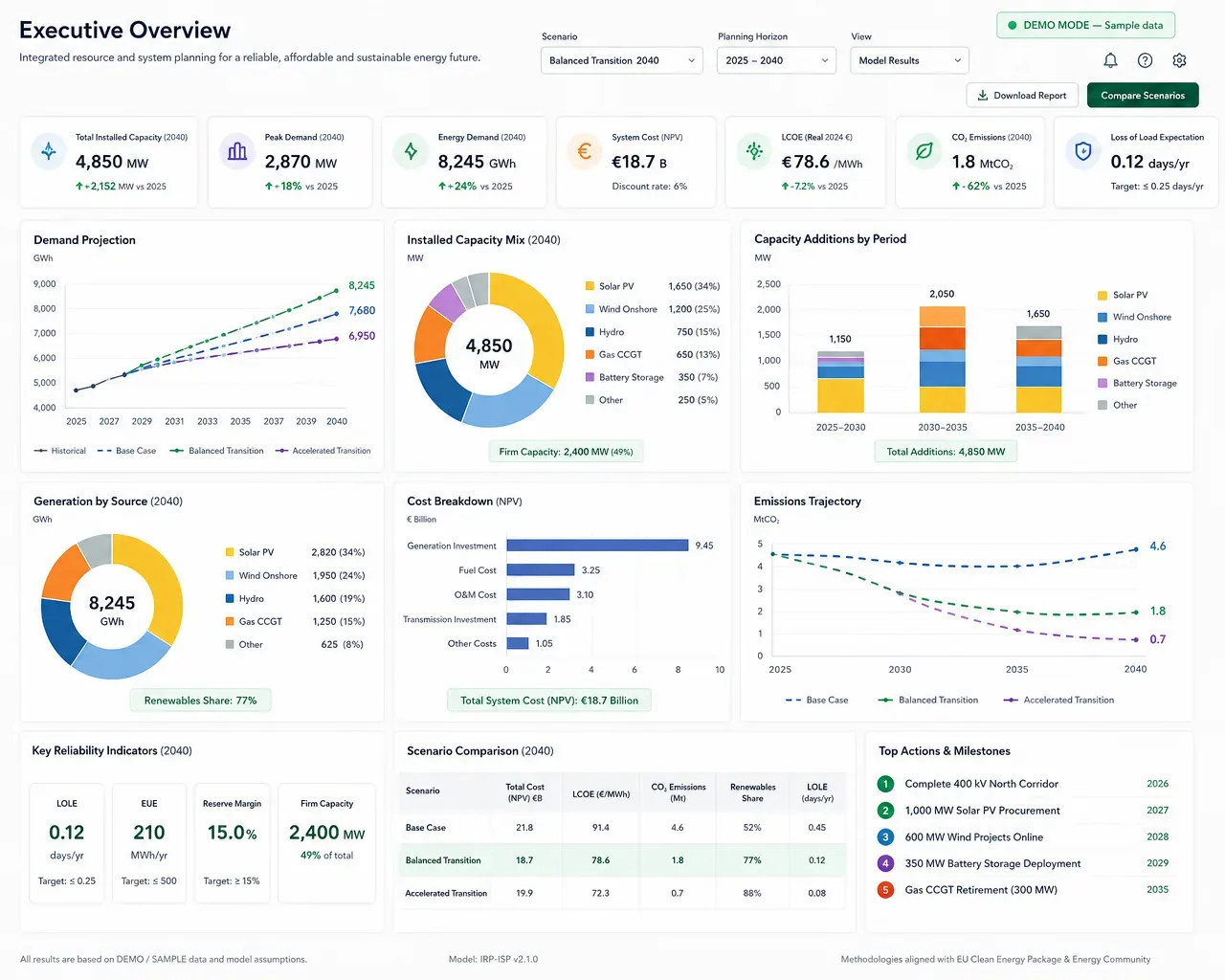
Builds least-cost capacity expansion pathways across generation, storage and demand-side resources, then reports them in the three forms a planning decision actually travels in: an executive summary, a policy brief and the underlying workbook.
What it looks like
Decision supported
Which resources to build, in what order, and whether a stated target is deliverable by the system that has to carry it.
Intended user
Utilities, TSOs and DSOs, ministries and regulators, and donor programmes commissioning long-term planning studies.
What goes in, what comes out
- Historical and projected demand
- Existing generation fleet with technical and cost parameters
- Fuel and carbon price trajectories
- Network constraints or connection queue at whatever resolution exists
- Policy targets and reliability standards the plan must satisfy
Integrated Resource & System Planning Platform
- Least-cost expansion pathway by technology and year
- Scenario comparison under demand, fuel-price and policy uncertainty
- Resource adequacy assessment against the applicable standard
- Executive summary, policy brief and full workbook from the same run
What goes in and what comes out. The model itself — its formulas, weighting and optimisation logic — is method, not proof, and is not drawn here.
Methodology summary
Scenario-based capacity expansion. Each run is named and versioned, and every published figure traces back to a specific run rather than to a spreadsheet someone edited afterwards — which is what makes a result defensible in front of a regulator months later.
Limitations
- Results are only as good as the network representation supplied; where a connection queue does not exist in usable form, grid constraints are approximated and the assumption is stated.
- Least-cost optimisation reflects the costs and constraints entered. It does not price political feasibility, procurement capacity or institutional readiness — those are assessed separately and deliberately outside the model.
- Not a real-time operations or dispatch tool. It answers investment-horizon questions, not what to run tomorrow.
Public preview
Access model
Applied within an engagement. The client keeps the model and documentation so their own team can re-run it after we leave — a model nobody can re-run is a deliverable, not a capability.